How to Insulate a Garage Floor
Thin floor insulation can make a big difference when converting a garage
Knowledge Article5 min read
© 2026 Kingspan Holdings (IRL) Limited, All Rights Reserved
For most self-builders, one project is more than enough of a challenge for a lifetime. In the case of John and Sue Askew, however, it was just the start. Beech House, near Wisbech, is their 5th project and the couple took a hands-on approach to the build. The modern farmhouse offers stunning views of their surrounding farmland and has been built with a highly insulated brick and metal construction featuring a range of Kooltherm products and QuadCore KS1000RW Roof Panels.
The building form was an evolution of a traditional grain store design, with the pitched roof separated and a central flat roofed section added. Materials also reflect those found in modern agricultural buildings including brick, trapezoidal cladding and the use of QuadCore KS1000 RW Roof Panels for the pitched roofs. These panels, in combination with a range of Kooltherm products, supported a highly energy efficient construction.
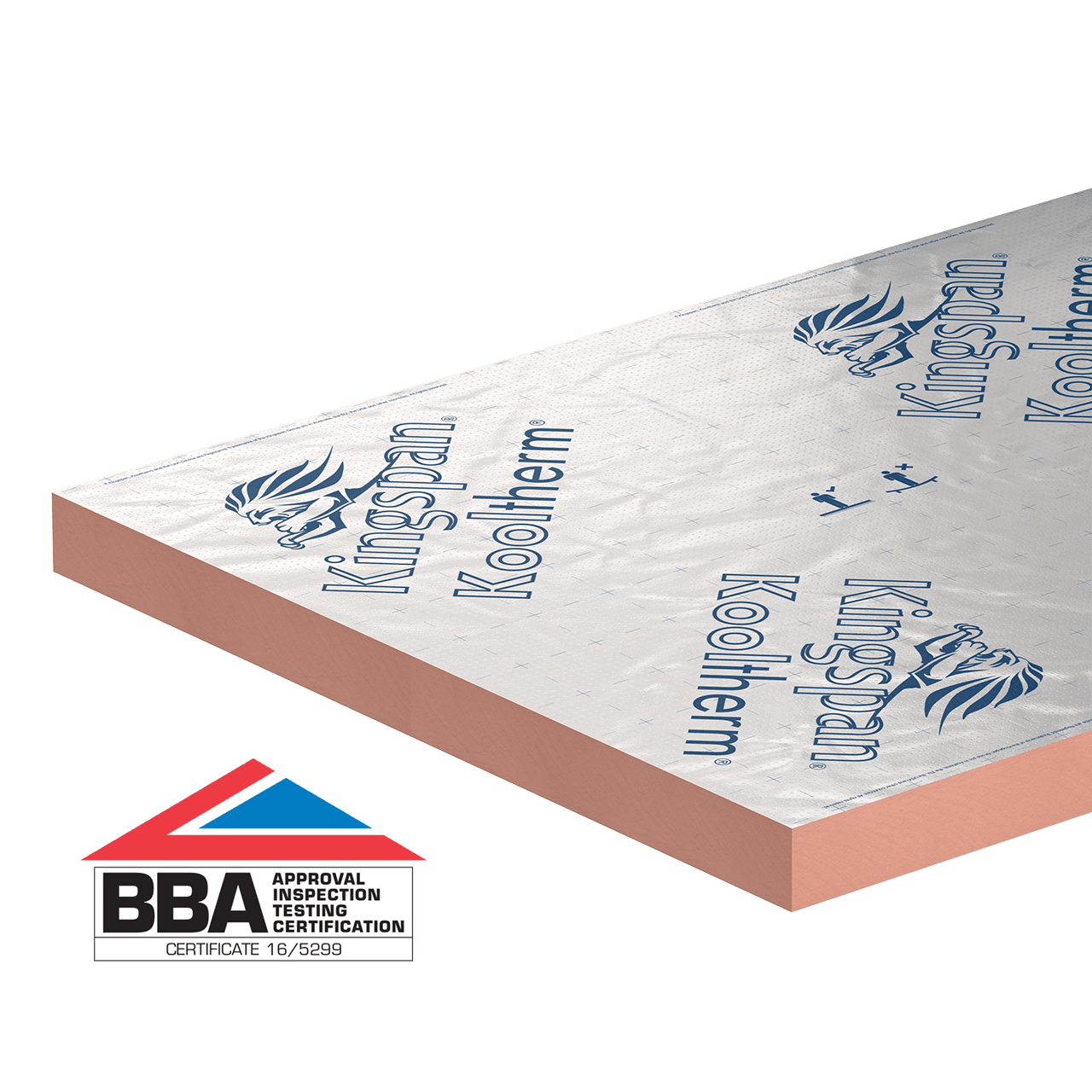
The home has been constructed with a beam and block floor, and to insulate this, Swann Edwards specified a 150 mm thickness of Kooltherm K103 Floorboard. The rigid insulation boards are suitable for use on beam and block, solid concrete and suspended timber floors and have a

Set on the couple’s 550-acre farm, the detached farmhouse and garage was designed by Swann Edwards Architecture. The project’s location presented a key hurdle during the design process, as restrictive rural planning requirements may have prevented the build. To overcome this, the project needed to be deemed to meet the exceptions set out in Paragraph 79 (now Paragraph 82) of the National Planning Policy Framework (NPPF).
The home also features a large roof terrace leading out from the master bedroom. To ensure an even transition between the internal and external spaces on the first floor, and a consistent ceiling height on the ground floor, the architects specified a construction featuring Kooltherm K107 Pitched Roof Board and Kooltherm K118 Insulated Plasterboard. Kooltherm K118 provides insulation, drylining and vapour control in a single board.
As with Kooltherm K103, the insulation component of both these products achieves a thermal conductivity of 0.019 W/mK, allowing for a slimmer construction than would have been possible with lower performing insulation products. All the Kooltherm products are lightweight and can be readily cut to dimension with a fine-toothed saw, allowing the project team to complete the installation rapidly.
Project Architect, James Burton, discussed the specification:
“The Kooltherm boards are commonly used across the industry and are simple to install so we were confident in specifying them. Their excellent thermal efficiency was also key in allowing us to achieve our fabric targets without compromising on the design of internal spaces.”
The use of QuadCore KS1000RW Roof Panels for the eye-catching multi-pitched roofs provided a number of project benefits as James Burton went on to explain:
“The panels are well insulated and are commonly used in agricultural projects and all the project team were familiar with using them.”
The QuadCore insulation within the panels achieves a thermal conductivity of just 0.018 W/mK. This performance is further supported by their panelised design and jointing system which ensure a uniform thickness and continuity of insulation across the property’s pitched roofs.
KS1000RW Roof Panels are suitable for pitched roof application of 4° or more after deflection and their prefabricated form helped to further support rapid installation on Beech House, allowing the building to quickly be made weathertight.
Images: Cillacam Photography
Products Used in this Project

To support compliance, Swann Edwards developed a design that was sympathetic to the surrounding architecture.
Kooltherm K107 Pitched Roof Board
Premium performance pitched roof insulation boardKooltherm K118 Insulated Plasterboard
Premium performance internal wall insulation