As garages were originally intended as unheated spaces, many feature solid wall constructions. These allow high levels of heat loss and will need to be properly insulated if you intend to convert the room into a liveable space. In this article, we look at how to get the best results when insulating garage walls.
Don't forget if you are a homeowner, our Homeowner Hub has more information on upgrading your property.
Solid wall installations, whether internal or external, require careful planning and an eye for detail. Before ordering any insulation, it is important to assess the building for any defects which might cause issues. These include any clear signs of damp or moisture on the walls or issues which could lead to this including missing pointing, damaged gutters or an absent damp proof course. These must all be carefully assessed before you start any work.
The guidance provides U-values, which are a measure of how thermally effective a thermal element (the roof, walls or floor) is. Learn more about U-values.
England & Wales
In England and Wales, where a garage is being converted to become part of the heated building, then the walls must meet the requirements for adding and replacing thermal elements, or the requirements for renovating elements (depending on the work being carried out).
When adding or replacing a thermal element (i.e. a wall), an area-weighted worst case U-value of 0.18 W/m2K should be achieved. A worse U-value could be met if meeting 0.18 W/m2K would result in a reduction of more than 5% of the internal floor area of the room.
When 50% of the surface area of an element (i.e. a wall) is being renovated, or more than 25% of the surface area of the external envelope (the roof, walls and floor) is being renovated, the wall should achieve a U-value of 0.55 W/m2K (for cavity insulation), or 0.30 W/m2K (for internal or external insulation). If this isn't technically or functionally feasible, or would not provide simple payback (download our Building Regulations guides for further information) within 15 years, the walls should be upgraded to the best possible U-value which can achieve simple payback within 15 years. This should typically be 0.70 W/m2K or better.
Scotland
In Scotland, where a part of a building is converted into a dwelling space from an alternative use, or unheated space (like a garage), the walls should be insulated to achieve a U-value of 0.17 W/m2K. However, where this is not possible, the design team should provide evidence of why this is the case (for example a lack of space for insulation) and what options have been considered. The worst case U-value that should typically be achieved is 0.70 W/m2K.
The thickness of the insulation needed will depend on the type of wall construction your garage uses and the insulation product you choose. Insulation products with lower thermal conductivities (lambda values) are more effective at preventing heat loss, meaning a slimmer thickness can be fitted.
If the garage has a cavity wall construction, then this can typically be insulated with blown insulation such as polystyrene balls. If the cavity is too slim for this, or if there is no cavity (a solid wall), then the only options are to fit external wall insulation (EWI) or internal wall insulation (IWI). As you might imagine, EWI goes on the outside of the wall (typically behind a render system), whilst IWI is fitted internally.
You can use our U-value calculator to find the correct product thickness to achieve your target U-value in EWI or IWI applications.
How to prevent condensation issues when insulating garage walls
It’s important to be aware that correctly fitted internal or external wall insulation will make a garage more airtight. This is beneficial as it reduces unwanted drafts, but care needs to be taken to ensure you have a good supply of fresh air in the space. This may include fitting windows with trickle vents or a dedicated extraction fan.
How to install external wall insulation (EWI) on a garage conversion
EWI systems offer a couple of advantages. As the insulation is fitted on the outside of the garage, you don’t lose any space inside. In addition, as the insulation effectively sheaths the outside structure, there’s less chance of thermal bridges. These are areas where materials that are better conductors of heat than the insulation are allowed to form a path between the inner and outer face of the construction. If not addressed, these can allow a lot of heat to escape and also cause issues with damp.
It’s recommended that EWI installations are carried out by trained professionals who will typically apply the outer cladding or render system at the same time. Once the wall is checked to ensure there are no issues, a bonding compound is applied. The insulation, such as Kooltherm K5 External Wall Board, can then be fitted to the wall and firmly fixed in place with mechanical fixings. The chosen render system is then applied.
Of course, EWI won’t work for everyone. If space around your garage is particularly limited or you simply want to retain the original appearance, you’ll need to consider an IWI installation.
How to install internal wall insulation (IWI) on a garage conversion
Vapour open systems – these typically include the use of insulation materials such as wood fibre. These products allow moist air to pass in and out of the wall, preventing the wall from becoming saturated and causing issues with damp. The downside is that the insulation layer needs to be relatively thin as they rely on heat from inside your home to enter the construction, causing any moisture to evaporate.
Vapour closed systems – these include products such as Kooltherm K118 Insulated Plasterboard which are vapour closed, preventing moist air from passing through. The benefit of these constructions is that you can insulate the walls to a higher level but you must be careful to ensure that there is a continuous vapour barrier internally to prevent moist air from entering the construction. Additional measures may also be needed externally to stop moisture from entering the construction.
The most appropriate approach may depend on a variety of factors including the design of your garage and how permeable the brickwork is. If you’re not confident in installing these measures, it’s worth getting a professional in to properly assess the building and make recommendations. This can be carried out under the new Retrofit Framework set out in PAS 2030: 2023 and PAS 2035: 2023.
For this article, we’ll look at the approach when fitting Kooltherm K118 which is a vapour closed product combining plasterboard, insulation and vapour control in one.
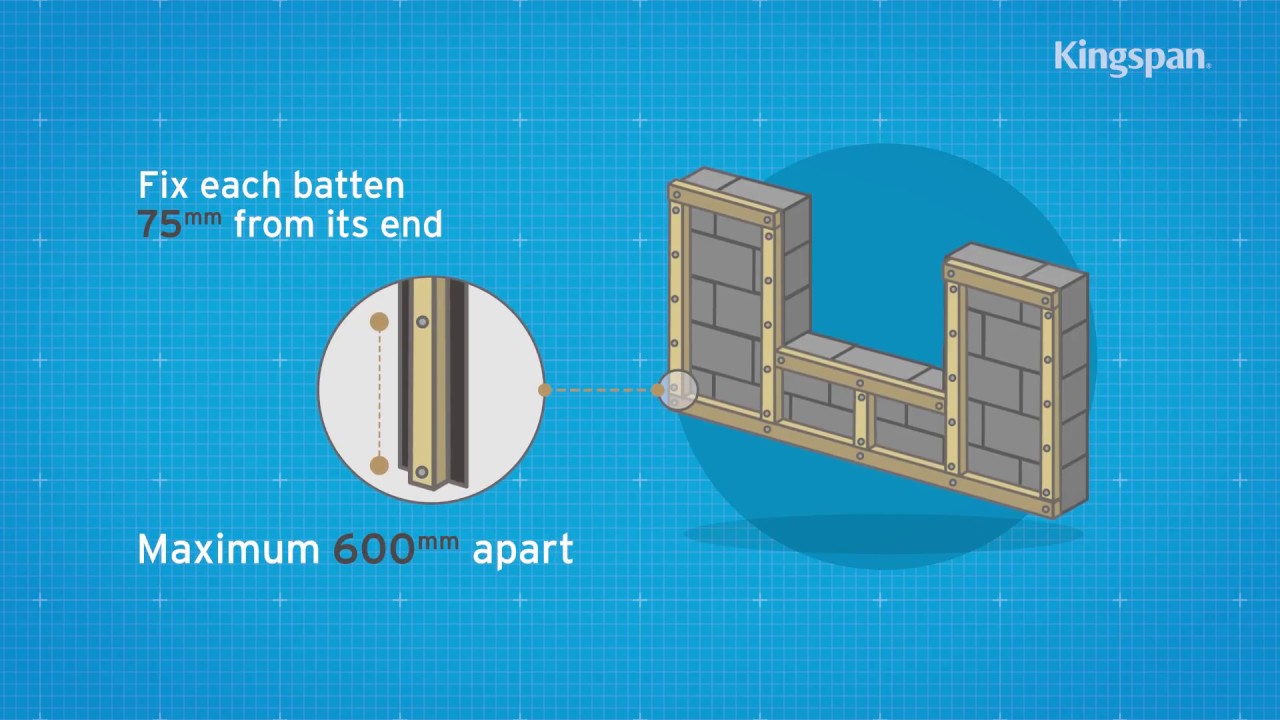
The insulated plasterboards can be screwed to timber battens at 600 mm vertical centres. This can either be done with drywall screws at the 300 mm centres or with large-headed galvanised clout nails at 150 mm vertical centres.
So that the plasterboard is secure, there should be at least 22.5 mm of penetration into the timber battens. These battens should have additional protection from moisture with a damp-proof-course strip, placed between the batten itself and the wall. Additionally, timber noggins should be positioned horizontally at the floor and ceiling level, at a maximum of 1200 mm vertical centres. Combining these products and processes will both insulate your garage conversion and provide a vapour control layer in a single installation.
If your pre-existing garage has an impervious finish to its exteriors, such as timber cladding or a waterproof render, then insulated plasterboard can be fixed to the wall’s interior using a ‘dot and dab’ method. It’s always a good idea to complete an exposure risk analysis, such as the ones offered by Kingspan’s Technical Services team, as some locations or special circumstances can mean this method is inappropriate.
Finally, there is the option to build a timber frame system, incorporating a breathable membrane and insulation between the studs and plasterboard. This method is a way to correct heavily uneven brickwork, so not appropriate in all circumstances, with plastic shims available to sit behind timber battens if there are smaller inconsistencies in the wall’s surface.
How do I insulate around doors and windows in a garage conversion?
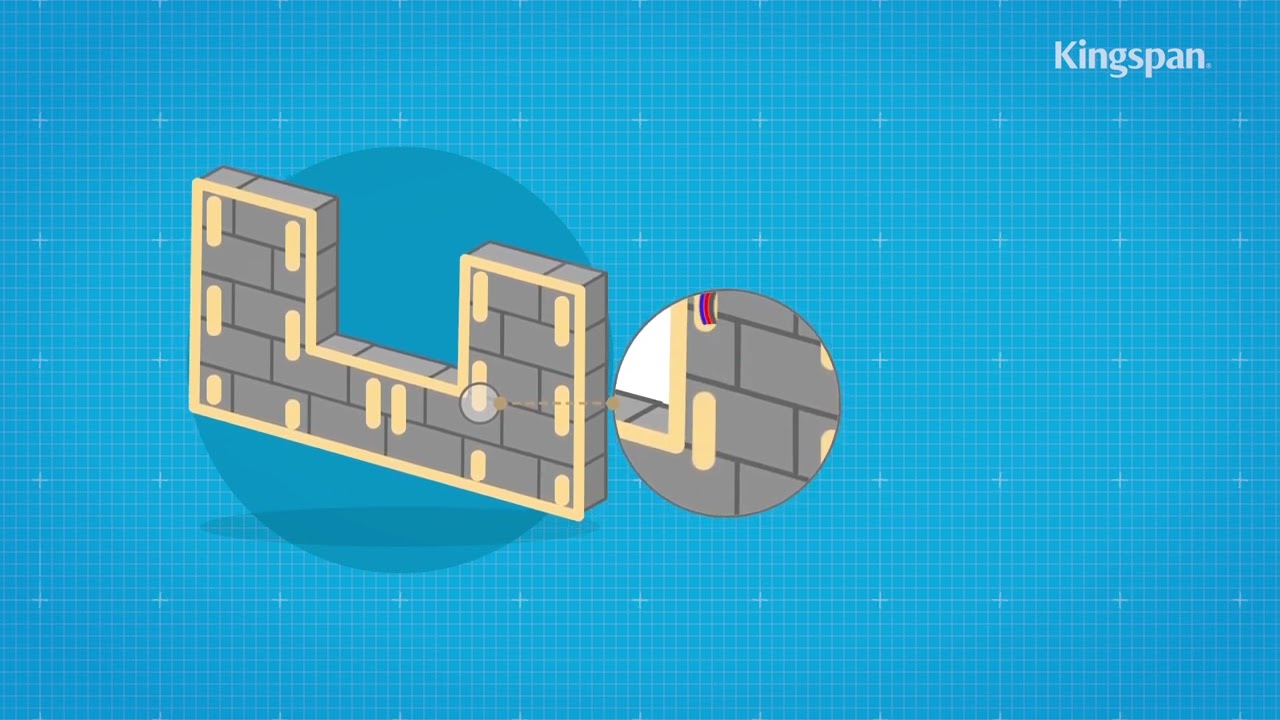
It’s important to take particular care when fitting insulation around openings such as windows and doors as these can be a key source of heat loss. One way to do this is by fitting wooden battens around openings to support the board edges and act as a way to fix insulation. A 25 mm min. thickness of Kooltherm K118 can then be installed.
How do I deal with the wall between a garage conversion and the existing house?
Since there is no longer such a drastic change in temperature between the cold garage and the warm house, with the aim to keep both spaces comfortably warm, there is no need to insulate the wall between your house and the new garage conversion.