Masonry cavity walls are a popular choice of construction method for homes and other buildings across Britain. However, following the updates to the Building Regulations and Standards in 2022 and 2023, these constructions may now need to be insulated to a much higher level. This can have a significant impact on the thickness of both the insulation and overall wall construction, potentially shrinking available living space within the building.
In this guide, we'll look at the cavity wall insulation requirements for both domestic and non-domestic buildings, and how more thermally efficient insulation solutions can allow you to maintain a slimmer cavity whilst meeting building standards.
What U-value should new cavity walls achieve?
A good starting point when deciding how well insulated cavity walls need to be is to look at the notional building specification for your country. These specifications are contained in the guidance documents which explain how to achieve compliance with the energy efficiency requirements in the Building Regulations and Standards. These are known as:
- Approved Document L 2021 in England (ADL 2021)
- Approved Document L 2022 in Wales (ADL 2022)
- Technical Handbook 6 2022 in Scotland (TH6 2022)
Each of these documents set key metrics for aspects such as carbon emissions and energy demand which new buildings must meet. To calculate the specific targets for a project, the notional building specifications are applied to a theoretical building of the same dimensions as the one expected to be built. The targets are then based on the outputs from this model. Project teams are free to vary from the specification provided they achieve all of the compulsory metrics. However, the values provide a useful indication of the performance a building must achieve.
The notional building specification for external walls on new projects are shown in the table below:
| Area-weighted U-values (W/m²K) | |||
|---|---|---|---|---|
| Domestic | Non-Domestic | ||
Side-lit and unlit (such as offices and schools) | Side-lit and unlit (with cooling) | Top-lit (such as warehouses) | ||
England - ADL 2021 | 0.18 | 0.18 | 0.18 | 0.26 |
Wales - ADL 2022 | 0.13 | 0.22 | 0.26 | 0.26 |
Scotland - TH6 2022 | 0.15 | 0.15 | 0.15 | 0.15 |
What are the minimum U-values for new cavity walls?
ADL 2021, ADL 2022 and TH6 2022 also set minimum U-values, in the form of allowable ‘area-weighted’ U-values for each element, which all new properties should achieve or better. It is important to note that these are designed as limits not targets and that it will be difficult to achieve compliance if external walls are built to these values. It is also important to note that it is possible for specific areas of the element to achieve poorer U-values than these, providing the overall average performance for that element compensates for that.
Area weighted U-values (W/m2K) | ||
| Domestic | Non-Domestic |
England – ADL 2021 | 0.26 | 0.26 |
Wales – ADL 2022 | 0.18 (dwelling house), 0.21 (flats and apartments) | 0.26 |
Scotland – TH6 2022 | 0.17 | 0.21 |
When can I use full fill cavity wall insulation?
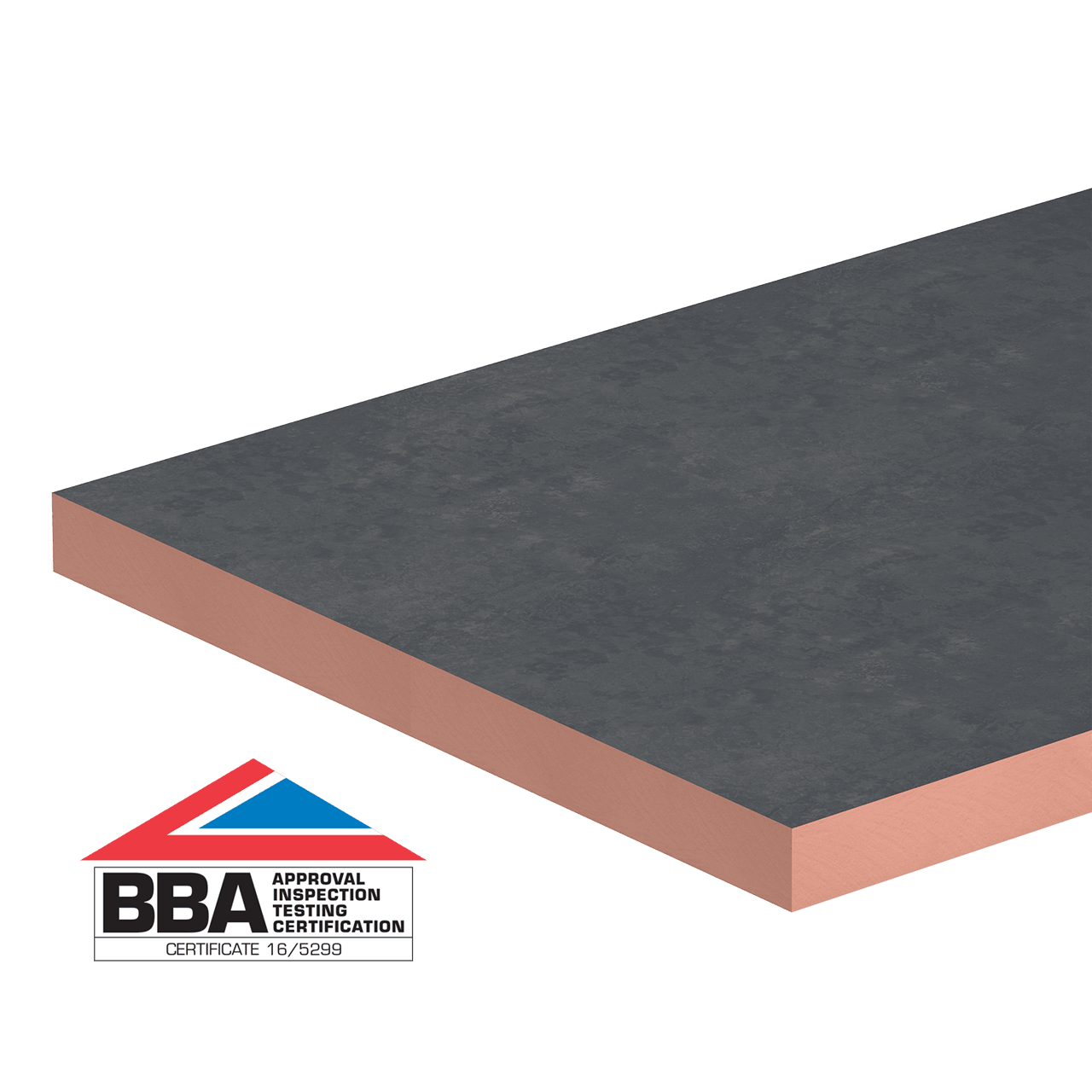
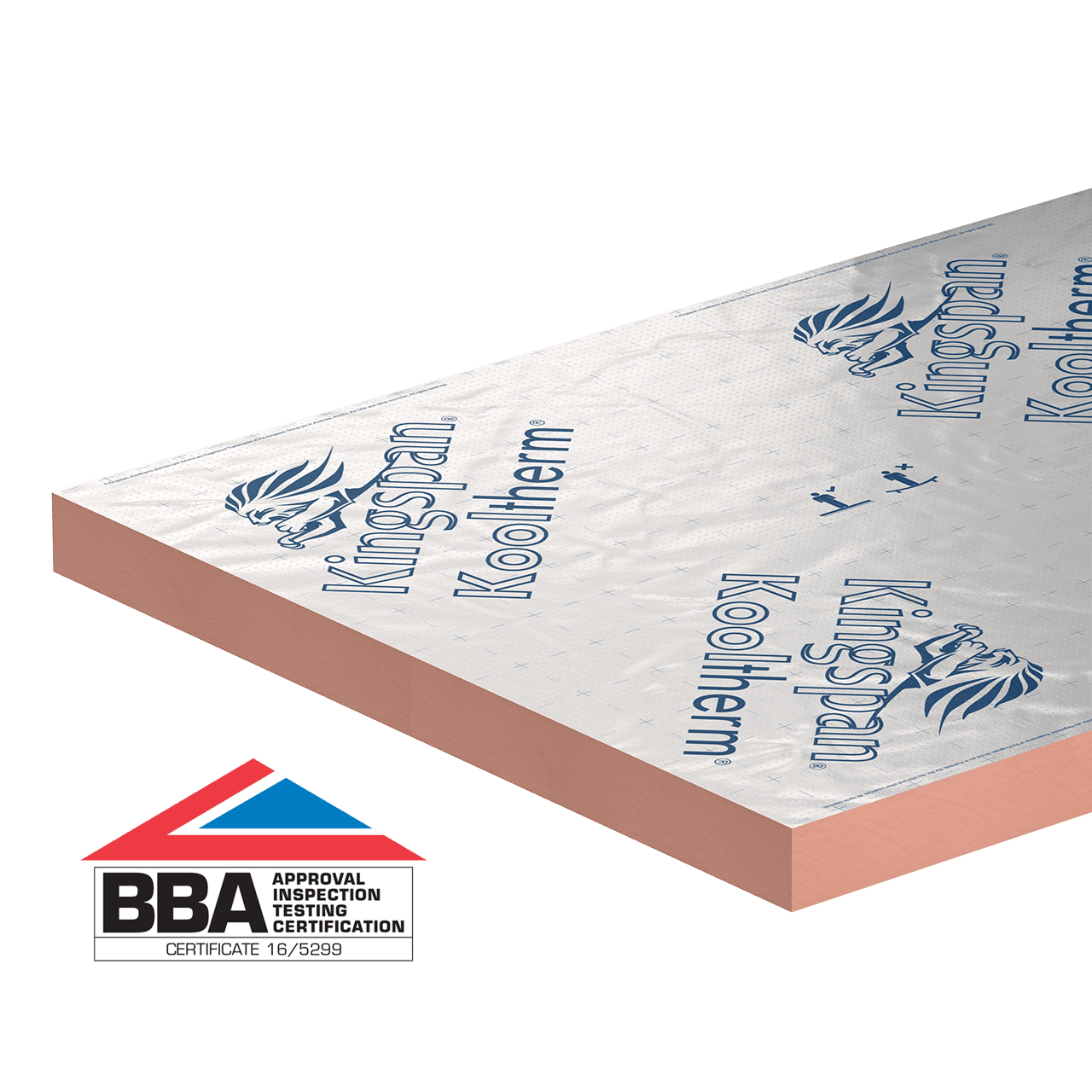
Cavities were first introduced into walls as a way of managing moisture which enters a construction, preventing it from getting inside the property and causing damp. However, improvements in building materials and construction approaches mean it can now be possible to create a ‘moisture closed’ construction, which allows far lower levels of moisture ingress. This can allow the use of full fill cavity solutions, such as Kooltherm K106 Cavity Board, which require little or no residual cavity meaning a greater thickness of insulation can be used without increasing the overall wall depth.
Before specifying a full fill insulation, however, it is important to understand how likely the property is to be exposed to wind-driven rain. The greater the exposure risk, the more likely moisture is to enter a construction. A map of exposure risk is provided in section 6.1.6 of the NHBC Standards. This separates properties into four risk categories: Very Severe, Severe, Moderate and Sheltered. Depending on the risk for a particular property, you may need to use a partial fill insulation solution, such as Kooltherm K108 Cavity Board, with a minimum 50 mm residual cavity.
What thickness of cavity wall insulation should I install?
This will depend on several factors— most importantly the thermal conductivity of the cavity wall insulation and the other construction materials. The lower the thermal conductivity of the materials, the more effective they are at stopping heat loss. This can reduce the overall thickness of insulation needed to achieve a desired U-value.
Find out more about thermal conductivities.
Kooltherm K106 and K108 have a thermal conductivity of 0.019 W/mK. This is lower (better) than some other commonly used options, such as mineral wool insulation, and can have a significant impact on the overall construction depth.
In the table below, we’ve looked at a few different options for insulating a typical cavity wall construction with a cavity width of between 100 and 150 mm, in line with standard industry practice.
Construction | Insulation and residual cavity | Blockwork type and wall U-value (W/m2K) | |||
Aerated (0.11) | Lightweight (0.15) | Medium (0.51) | Dense (1.13) | ||
102.5 mm brick outer leaf | 1. 90 mm Kooltherm K106 with 10 mm cavity | 0.16 | 0.17 | 0.18 | 0.18 |
2. 115 mm Kooltherm K106 with 10 mm cavity | 0.13 | 0.14 | 0.14 | 0.15 | |
3. 75 mm Kooltherm K108 with 50 mm cavity | 0.17 | 0.18 | 0.19 | 0.19 | |
4. 100 mm Kooltherm K108 with 50 mm cavity | 0.14 | 0.15 | 0.16 | 0.16 | |
Traditionally, housebuilders have preferred to use a 100 mm cavity. In construction 1, you can see that it is possible to achieve, or improve on, the notional values for dwellings in England with a 90 mm thickness of Kooltherm K106 and a 10 mm cavity.
By extending the cavity width to 125 mm and fitting a 115 mm thickness of Kooltherm K106, it is possible to achieve the notional values for dwellings in Scotland (although it should be noted that many Scottish projects will require the use of partial fill insulation due to the wind-driven rain risk). In addition, by using an aerated blockwork inner leaf, it is also possible to achieve the values set out in Wales.
Where a partial fill insulation is needed, it is possible to achieve the notional dwelling requirements in England with a 75 mm thickness of Kooltherm K108 and 50 mm cavity with either an aerated or lightweight blockwork inner leaf. Alternatively, by extending the cavity width to 150 mm and using either an aerated or lightweight blockwork inner leaf, it is possible to meet the notional values in Scotland.
U-value calculations
If you’re looking to check what thickness of insulation you need for your project, use our U-value calculator. This allows you to easily adjust the construction type to find what insulation you need.
Use our U-value calculator for cavity walls.