When choosing insulation there are a wide variety of factors to consider including material, thermal performance, sustainability, cost-effectiveness and available thicknesses.
We have insulation for a wide spectrum of uses and applications. Whether you are looking for a product with a very low thermal conductivity, a product with a Euroclass A1 fire rating or a product to improve the sustainability credentials of your project, we have a product to suit.
Vacuum Insulation Panels
What are Vacuum Insulation Panels? Vacuum insulation panels (VIPs) are a next generation insulation solution, which provide a high level of thermal efficiency with minimal thickness.
How are Vacuum Insulation Panels made? A microporous core is evacuated, encased and sealed in a thin gas-tight envelope. This removal of air eliminates almost all heat transfer. Take a look at our video to see the process.
What is the thermal conductivity of Vacuum Insulation Panels? OPTIM-R has a design thermal conductivity of just 0.007 W/mK.
Why choose Vacuum Insulation Panels? The low thermal conductivity of OPTIM-R makes it ideal for constructions where a lack of depth or space is an issue. The panels could provide a solution for previously uninsulated areas, perhaps due to insufficient available space or bevause the excavation of material is impractical. Or the panels could be used to significantly enhance the U-values that can be achieved in a construction.
Where can I use VIPs? VIPs can be used in a variety of new-build and refurbishment applications. They work particularly well in cases with space constraints such as flat roofs and terraces.
Microporous silicia insulation
What is microporous silica-based insulation? This insulation features a water-repellant, microporous silica-based core, which can achieve high levels of thermal and reaction to fire performance. The core can be supplied without a facing or can be sewn into glass fibre fabric.
How is microporous silica-based insulation made? AlphaCore is created by mixing and dispersing solid ingredients like fumed silica, opacifier and fibres into a powder mix. The resulting mixture is compacted into a hydrophilic board, cut to size and then chemically converted into the final insulation board.
What is the thermal conductivity of microporous silica insulation? AlphaCore has a thermal conductivity of 0.020 W/mK.
Why choose microporous silica-based insulation? Microporous silica-based insulation solutions such as AlphaCore achieve a Euroclass rating of A2-s1,d0 to EN 13501-1. In combination with its thermal performance, this allows it to provide a much slimmer alternative to conventional A1 or A2 class insulation in applications where enhanced reaction to fire performance is required.
Where can I use microporous silica-based insulation?AlphaCore Pad is suitable for use on structural ceilings (soffits) and behind rainscreen facades. AlphaCore Pure is suitable for use in OEM application systems.
Phenolic insulation
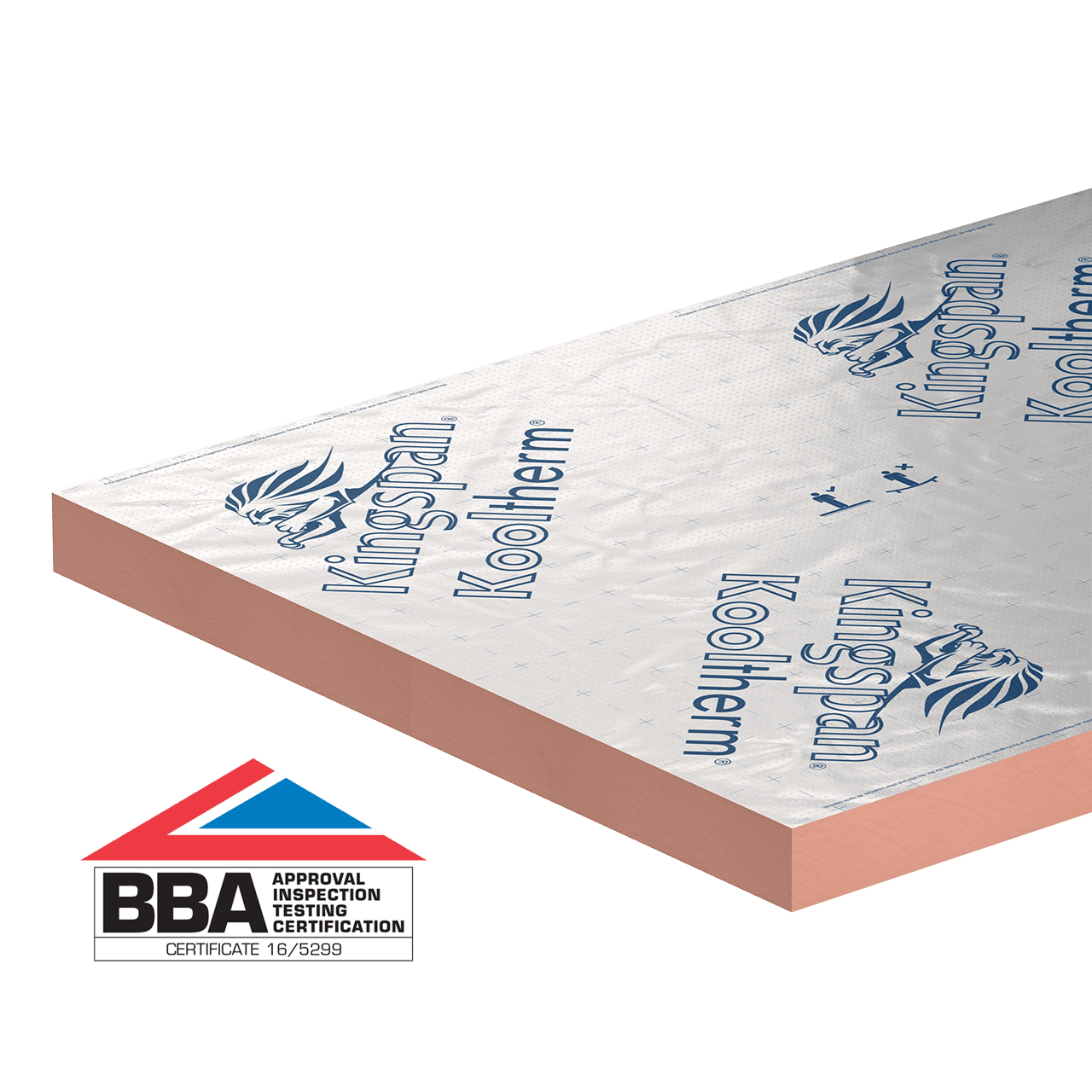
What is phenolic insulation? Phenolic insulation is a rigid insulation with a closed-cell structure.
How is phenolic insulation made? A wet foam mix is added directly to the bottom layer of the facing. It then expands to meet the top layer. This is then cooked under pressure and cured in a second oven. When it’s ready, the phenolic insulation boards are cut to the right size and packaged up.
What is the thermal conductivity of phenolic insulation? Our lower-lambda Kooltherm insulation achieves a lambda value of 0.019 W/mK across all thicknesses.
Why choose phenolic insulation? Phenolic insulation is the most thermally efficient insulation commonly used – helping you to meet energy building regulations.
Where can I use phenolic insulation? It can be used in a variety of roof, wall and floor applications, which makes it a great solution for a range of constructions.
PIR insulation
What is PIR insulation? Polyisocyanurate (PIR) is a thermoset plastic produced as a foam. This is bonded to a facing to create an insulation board.
How is PIR insulation made? Like phenolic insulation, PIR is cooked under pressure in the factory and left to cool. It’s then cut to size and packaged up. Take a look at our video to see the process.
What is the thermal conductivity of PIR insulation? The lambda value of our Therma range goes as low 0.022 W/mK.
Why choose PIR insulation? PIR is available for many applications and is amongst the more thermally efficient insulation products commonly used.
Where can I use PIR insulation? PIR insulation is often used on flat roof applications, due to its durability and compatibility with a variety of waterproofing methods. However it can also be used in a wide range of further applications.
XPS insulation
What is XPS insulation? XPS (extruded polystyrene) is a rigid foam insulation made from polystyrene.
How is XPS insulation made? It is manufactured by liquefying polystyrene pellets then injecting a blowing agent under pressure. Once cooled, this creates a closed cell rigid foam.
Why choose XPS insulation? It is significantly denser than other types of insulation, which gives it a greater compressive strength. Its closed cell structure also resists both moisture and water vapour ingress.
Where can I use XPS insulation? Due to its compressive strength, XPS is regularly used in applications where it is going to be under some strain, such as car park decks. It’s also great for use in basements and inverted roofs due to its resistance to water absorption.
Rock mineral fibre insulation
What is rock mineral fibre insulation? Rock mineral fibre is a slab insulation formed from woven stone fibres which are combined with chemical binders.
How is rock mineral fibre insulation made? Rock mineral fibre is produced by heating basalt stone to over 1400 °C. The molten material is then spun on specialist wheels to form fibres. Chemical binders are also applied during this process to form a wool slab. The slab is then cured in an oven and cut to size.
What is the thermal conductivity of rock mineral fibre insulation? Our K-Roc range products have thermal conductivities between 0.034 – 0.039 W/mK.
Why choose rock mineral fibre insulation? K-Roc range products achieve a Euroclass rating of A1.
Where can I use rock mineral fibre insulation?K-Roc Rainscreen Slab can be used behind rainscreen façade systems, whilst K-Roc Framing Slab is suitable for use in steel frame systems. K-Roc Flat Roof Slab 70/039 is for use on flat roofs waterproofed with mechanically fixed single-ply waterproofing. K-Roc Soffit Slab can be used on structural ceilings (soffits).
Wood fibre insulation
How is wood fibre insulation made? Wood fibre insulation is made from wood chips which are milled and dried then put into a mix with binding agent to make a ‘mattress’ of fibre. This is then formed into the finished slab or board.
Why choose wood fibre insulation? Wood fibre products are generally specified on projects with a requirement for bio-based products or when the client is seeking to improve the sustainability credentials of their project.
What is the thermal conductivity of wood fibre insulation? Our STEICO range of wood fibre insulation compares well against other bio-based products such as sheep's wool and hemp, and has thermal conductivities between 0.036 - 0.043 W/mK.
Where can wood fibre be used? STEICO flex 036 is a flexible slab and STEICO universal dry is a rigid sheathing board, generally used between frames or studs in timber frame walls and pitched roofs.